William Barnes
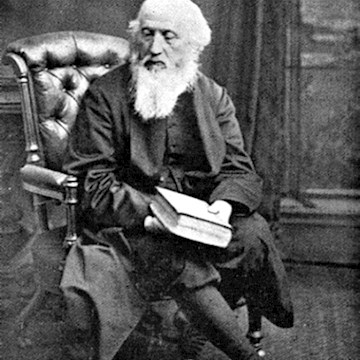
William Barnes
‘To where, vor me, the apple tree
Do lean down low in Linden Lea’
William Barnes [ 1801-1886] was a very remarkable man. Born in Sturminster Newton in North Dorset and very largely self-educated, he became an inspirational schoolteacher and later a compassionate and caring priest. In his leisure time he wrote poems about his early life growing up in the Blackmore Vale, and chose the Dorset dialect as the best means to convey the essence and spirit of his native county. The poems are of such beauty, quality and humour, that they are still loved and performed to this day.
The voices you will hear on these recordings are all of people who lived and worked in the Vale. The initial recording, Lydlinch Bells, was very largely based on Giles Dugdale’s lovely selection ‘Poems Grave and Gay’, and this was the book that many of the local readers around Fontmell Magna used in the 1960’s. Favourites such as John Bloom in Lon’on, The Shepherd o’ the Farm, The Wold Waggon and The Geate a-Vallen To can all be found here. Many people also have cherished copies of ‘Poems of Rural Life in the Dorset Dialect’ [the collected works first published in 1879], where all the other poems in this compilation can be found, with the exception of The Young Rhymer Snubb’d.
In 1801, the year of William Barnes’ birth, at least 90% of the population of the Blackmore Vale would have spoken in a dialect that we would now have difficulty in understanding. It was a language rooted in the countryside, full of specialised terms for the techniques of hand-farming, for the natural flora and fauna, rich with local anecdote and story. It was an entirely oral language, with vowel and consonant sounds passed down over many generations; perhaps, as Barnes maintained, from the time of King Alfred and the Anglo-Saxons.
Even in his own time, Barnes was very aware how the dialect was being weakened and diluted. The farmers and tradesmen who sent their sons to his school in Dorchester expected them to be educated out of a Dorset accent; for then, as now, a West country accent was snobbishly regarded as the lazy speech of country bumpkins who were too silly and slow to speak properly. It was to fight against this perception,, and to help his countrymen take pride in their native accent, that Barnes gave lectures on ‘The History of the Western English Folk Speech’, and then entertained his audience with readings of his poems.
Other Albums
