A Most Particular Vintage

by Bosun Higgs
£9.99
Overview
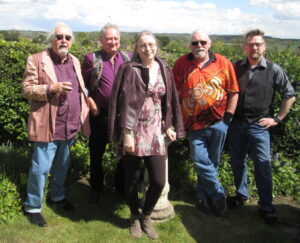
Bosun Higgs English Country Dance Band are a band who love to play for English dances, ceilidhs, etc – call them what you will. The line up of fiddle, melodeon, banjo, bass saxophone, and percussion produces a sound that is rooted in the English dance music tradition, is full of life and very danceable as well as listenable. Formed in 2019 from experienced dance musicians and dancers the band comprises Taz Tarry, Carly Rose, Keith Holloway, Neil Gledhill, and Martin Banks. They have long-established track records in well-respected combos including The Old Swan Band, Token Women, Random, and Grand Union all of which gives Bosun Higgs a traditional sound with oomph, swing and lift. Their repertoire contains a mixture of great traditional tunes as well as more recently composed tunes and some written by members of the band.
Notes to the tunes
- Fred Pidgeon’s No. 1/Babes in the Wood (Trad/Trad)
Two standard English traditional tunes. Fred Pidgeon (1880-1970) was a fiddler from Stockland in Devon. Babes in the Wood is also known as Captain Maguire’s.
- Out to Lunch/Old Man Quinn (Taz Tarry/Trad)
Taz wrote Out to Lunch over one lunchtime at work. Old Man Quinn is a traditional Irish hornpipe which we first heard played by the excellent English ceilidh band Gas Mark 5.
- Horse and Jockey/Wigan Peer/You may if you please (Taz Tarry/Keith Holloway/Trad)
Horse and Jockey is the first tune Taz ever wrote, in 1988, and it is named after a pub of the same name in Hitchin which used to hold music sessions. Sadly, the pub has now been demolished. Keith wrote Wigan Peer for a clog step dance some years ago, when Keith was playing for a dance side. The dance had been taught by Geoff Hughes, from Wigan, so the title was fairly obvious. You may if you please is a traditional jig which we felt would round the set off well, especially for those three couple dances which often go nine times through.
- Haughton House/Quigley’s Reel (James Mitchell/Trad)
Taz got Haughton House from Tim Brooks at Bromyard Folk Festival one year. It has also been recorded as Auchdon House – possibly a mis-hearing of the Scottish pronunciation. Taz learnt Quigley’s Reel from Howard (Mitch) Mitchell. It is a traditional tune from New England, with the alternative 19th century title of Atlanta Hornpipe predating the name of Quigley’s Reel by which it is now often known. Al Quigley was a New England fiddle player who used to play it. With acknowledgement to the Traditional Tune Archive for this information.
- Snowday Waltz/Dream Waltz (David Margolin/Taz Tarry)
Snowday Waltz was written by David Margolin, and was recorded on the Sweet Nell CD. Dream Waltz came to Taz in a dream and fortunately the memory of it was largely still there when he woke up, so, after grabbing his fiddle and a little bit of work, here it is.
- Taylor’s Ale/The Alston Fiddle (Taz Tarry/Taz Tarry)
Two reels written by Taz. Taylor’s Ale is so named after his favourite brewery, Timothy Taylor’s of Keighley. Great beers. The Alston Fiddle was written for a fiddle Taz found in a second-hand shop in Alston, Cumbria. It said ‘buy me’ and after having it restored, it turned out to be quite a good instrument.
- The Swiss Girl/Prince Albert’s Jig (Trad/P J Headford)
The Swiss Girl is from the manuscript music book of Thomas Hardy the novelist’s father, who was also called Thomas Hardy. Prince Albert’s Jig was written by the wonderful fiddler and our great friend Flos Headford. It is named after the Prince Albert Inn in Stroud, which used to be home to an excellent weekly English music session, and still welcomes live music of many different types.
- Clee Hill/A Trip to Bavaria (melody from the song Die Fischerin vom Bodensee) (Trad/Franz Winkler)
Clee Hill is a well-known traditional tune, originally collected from Dennis Crowther from the village of Cleehill. Clee Hills are a range of hills in South Shropshire, near Ludlow. The second tune is the melody from the Bavarian song Die Fischerin vom Bodensee (The Fisherwoman from Bodensee), written in 1947. Bodensee is the locals’ name for Lake Constance. The tune has also been used for a Scottish Country Dance called A Trip to Bavaria written by James MacGregor-Brown, hence it’s ‘English’ name. Neil got the tune from Roger Edwards.
- Wakes Barn Polka/What a Beau My Granny Was (Keith Holloway/Trad)
Keith wrote Wakes Barn Polka when playing for a wedding reception at Gilbert White’s House, in Selborne, Hants. Wakes Barn has been turned into a venue, and on that day the G & T’s were flowing, the sun was shining, and the result was this tune. What a Beau My Granny Was, originally learnt by Taz with the more mundane name of Sussex Polka, is from the William Aylemore’s manuscript (1796-1818). It can also found in one of the Lewes’ sessions ‘Lewes Favourites’ tune books. There is also a Scottish dance and corresponding (different) tune with the same name.
- Bang-up Hornpipe/Wiggington Windmill (Trad/Trad)
Bang-up Hornpipe was learnt from Cath Watkins of Jigfoot, whilst Taz learnt Wiggington Windmill from the collection of traditional Northern dance music, ‘A Northern Lass’, edited by Jamie Knowle. There used to be a pub called the Windmill Inn in Wigginton near York. It has been a private residence since 1939. Note the variant spelling for the place in the tune title, which occasionally turns up elsewhere.
- Deed Polka/Double Figure 8 (Taz Tarry/Trad)
Taz wrote Deed Polka after his fiancé, Jan, changed her surname to his by Deed Poll (see what I did there?) when they had to postpone their planned wedding. Double Figure Eight was made famous by The Old Swan Band and is now a standard in English music sessions, usually, as here, with the ’round three’ ending from the Old Swan Band’s version.
Reviews
Unicorn
Bosun Higgs English Country Dance Band are a bunch of established musicians who have played for a variety of outfits including the Old Swan Band amongst others. They were first formed in 2009 and comprise Taz Tarry on fiddle; Carly Rose on Percussion; Keith Holloway on Melodeons; Neil Gledhill on Bass Saxophone and Martin Banks on Banjo and Autoharp. ‘A Most Particular Vintage’ is the band’s new CD and meant to be a good representation of what you can expect to hear if you book them for a ceilidh. It is presented in a hard protective case which includes an eight-page pull-out with notes on all the tunes and an attractive looking bottle of wine on the front to illustrate the title. There are eleven tunes or combinations of tunes on the album being a mixture of traditional arrangements and those written by the band, most of them by fiddler Taz Tarry with contributions from Melodeon Player Keith Holloway. There is a nice balance of instruments at work here and enough variety to make this a very listenable CD as well as being a good advert for the excellent dance music that is perhaps the main aim. Whilst listening to the CD is a pleasure (and you can always enjoy a little dance at the same time!) I am sure that you will find it even more enjoyable to see and hear them in the flesh and better still from the dance floor. Their next booking is at Sidmouth Folk Festival from 29th July 2022 and you can find out more from their website: https://www.bosunhiggs.co.uk/
Essex Folk News – Anna Bass
With a five-piece line–up featuring melodeons, fiddle, autoharp, bass saxophone, banjo and percussion, you might be expecting a sound which was a little out of the ordinary, and it is – in the best possible way. These tunes are simply great fun. Many are originals written by members of the band, and although there are eleven tracks, each track consists of at least two tunes, making a total of twenty-three different tunes (and the CD comes with a booklet explaining the origin of each tune). They are beautifully played, and delivered with infectious energy – the recording captures a lovely “live” feel which is entirely appropriate for a dance band. The bass saxophone gives an emphatic depth to the sound, and the percussion adds a jaunty playful flavour which makes the sound very distinctive.
This CD will definitely make you want to dance – but even if there isn’t room, the variety of tunes and the general momentum of the performance makes this collection highly entertaining – a real gem. If you’re a fan of folk tunes, I would definitely recommend this CD. And if you’re not, it might just win you over.
Related Albums
