Tall Ships and Tavern Tales

by The Exmouth Shantymen
£9.99
Overview
Tall Ships and Tavern Tales
– a voyage in song from the high seas to a dockside ale house
This double album of songs is taken from their two part stage show of the same name. The first disc has 17 traditional sea shanties from the era of the tall ships the second a varied collection of 16, mostly traditional songs, which sailors might have enjoyed singing in a dockside tavern. The singing on the album is strong and forthright – have a listen to some clips on their sample video.
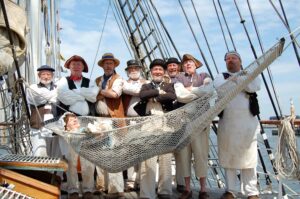
The Exmouth Shanty Men, Devon’s “original buoy band”, dress as merchant sailors on stage, adding actions to tight organic harmonies in a fun-filled performance. They have a strong following in the UK but are also popular on the continent, having played often in France, Belgium, Holland and Germany as well as Ireland. In 2022 they have been invited back to festivals at Ostend, Belgium and Krakow in Poland, where they have twice been proud to win the Stan Hugill trophy for the most authentic shanties.
The songs
Tall Ships
Leaving of Liverpool (Traditional) led by Billy Rollocks
Our long voyage on a tall ship begins, as did so many, from the premier port of Liverpool. By the late 1800s when American collector Richard Maitland learned this song from a Liverpool sailor, special emigration trains ran directly to Prince’s Landing Stage.
High Barbary (Traditional) led by Eamon Fyre
This shanty is based on a much earlier 16th century song, which told the fate of two merchant ships, the George Aloe and the Sweepstake. Very few shanties, being largely a product of the 19th century, make reference to the much earlier age of piracy.
Little Sally Racket (Traditional) led by Sam Minella
Whilst singing this shanty, early in the set, the crew pull on a rope as a reminder that shanties were work songs. Stan Hugill says in his book Shanties of the Seven Seas that this one is either from Barbados or Jamaica.
Bold Riley (Traditional) led by Anchorman
Was Jack glad to be going away, or sad to be leaving, or perhaps a bit of each? The origins of this song are shrouded in mystery, though Bert Lloyd sang it as a halyard shanty.
Good Morning Ladies All (Traditional) led by Levi Shore
The words “heave” and “haul” together in a song suggest a pump shanty. Stan Hugill, who worked as a shanty man, learned this one from West Indian seamen – who were a rich source of songs for British sailors.
Heilan Laddie (Traditional) led by Curly Quill
A walkaway or stamp-n-go song popular on Dundee whalers. It is based on an old Scottish march and dance tune and is of a fair age. A version was used working cargo in the timber ports of Canada and north-east America.
Reuben Ranzo (Traditional) led by Mal de Mer
Various theories describe Reuben Ranzo as Portuguese, Danish, Russian, Polish or American Latin! It is said to be a favourite song of the fo’c’sle (sailor’s living quarters on ship) because of the innuendo directed at the officers.
John Damarey (Traditional) led by Dai Wright
With its stamp and go chorus, it was popular on American ships – though it may actually have Polish origins. Sliding down the back stays, heavily tarred ropes holding the mast in place, was a faster route back to deck than the ratlines.
Billy Boy (Traditional) led by Canon Fodder
A variant of the traditional English folk song My Boy Billy, collected by Ralph Vaughan Williams. It is said to be a Northumbrian capstan shanty – though Hugill heard sailors from other parts singing it.
Lowlands Lowlands Low (Traditional) led by Billy Rollocks
Stan Hugill says this was a halyard song of West Indian origin. Cecil Sharp also collected it in Bristol, which had many ships and seamen of the Caribbean trade. The tune can be traced back to a comic opera of 1762.
Mobile Bay (Traditional) led by Eamon Fyre
We are in distant ports now! This probably started life as a cotton hoosiers song in the Gulf of Mexico, where Mobile is found. The shanty was used at pumps and halyards.
Johnny Come Down to Hilo (Traditional) led by Mal de Mer
Although Hilo is a port in the Hawaiian group, Hugill believes sailors were probably referring to the Peruvian nitrate port of Ilo. The tune is said to be Irish and the words a mixture of minstrel ditties and bits from other shanties.
Rollin Down to Old Maui (Traditional) led by Alfredo Heights
The crew of a whaling vessel look forward to their return to the Hawaiian warmth of Maui after a season in the Kamchatka Sea (in the far north Pacific). It is probably related to a song collected from the 1858 log of the Atkins Adams.
Down Trinidad (Traditional) led by Billy Rollocks
Collected from a Welsh sailor by James Madison Carpenter, but widely sung in Barbados. A burton is a term used for a block and tackle used in hoisting. “Booch free” and “in the archway” may refer to how barrels were stored in the hold of a ship.
Strike the Bell (Traditional) led by Anchorman
Late 19c songs to this tune include Ring The Bell Watchman (at the end of the American Civil War), and the Australian Click go the Shears, possibly a slightly later parody. Some think the pumping shanty Strike the Bell is older than both.
Shiny – O (Traditional) led by Sam Minella
James Hatfield, who crossed the Atlantic on a square rigger in 1886, collected this. “Shiny-o” may be a reference to the sweat on the bodies of men working the pumps. With mention of Queenstown (and Dover) we are getting closer to home!
Spanish Ladies (Traditional) led by Curly Quill
We’re almost back! The shanty probably dates from the late 1790s when Spain and Britain were still allies against Revolutionary France. It was most likely sung as ships were homeward bound. Collectors give different distances between Ushant and Scilly!
Tavern Tales
Heaven’s a Bar (Tim Laycock) led by Helen Highwater
The second half of our show “Tall Ships and Tavern Tales” is set in a quayside alehouse, and opens with landlady Helen Highwater singing this song, borrowed from Dorset’s Tim Laycock.
Jack was every inch a Sailor (Traditional) led by Canon Fodder
This traditional Newfoundland folk song is a loose and comical retelling of the biblical Jonah story, but with the whaler as hero. It may have been adapted from a New York music hall song Every Inch a Sailor, which itself was a burlesque of HMS Pinafore.
Betty Stogs (Martin John Nicholls) led by Sam Minella
An ode of adoration, penned by our former First Mate for his Beloved Betty, an agent for Skinner’s Brewery, with whom he made a tryst whene’er we docked in the pretty town of Falmouth.
Yarmouth Town (unknown) led by Cameron Nails
Peter Bellamy said he collected this song from a Norfolk friend who learned it from his grandfather. Oddly, there is no trace of it anywhere prior to the 1960s. But it’s a great yarn for our sailors to enjoy in the pub.
Old Fid (Bill Lowndes) led by Eamon Fyre
Bill Lowndes got to know a retired Norwegian sailor. The old man would look at his hands and say “Every thumb a marline-spike and every finger a fid”. A fid is a large tapering pin used to open the strands of a rope before splicing.
Fireship (Traditional) led by Mal de Mer
Stan Hugill says that this originated as a 17th Century English ballad, but was often sung at the pumps. The Weavers cleaned it up and had a 1950s hit with The Roving Kind.
Pay Me my Money Down (Traditional) led by Levi Shore
This is said to have originated as a protest song of black stevedores in Georgia and South Carolina ports, who were often swindled by unscrupulous ship captains slipping out of port without paying them.
Shenandoah (Traditional) led by Cameron Nails
Hugill describes three versions of this shanty, which dates to at least the 1820s. It may have originated among early American rivermen, or may have been a land song before it went to sea. Most agree it incorporates both Irish and African-American elements.
Handsome Cabin Boy (Traditional) led by Helen Highwater
A popular broadside ballad of shipboard carryings-on. Sung by Louis Killen (among others) whose version derives from that sung by one of the greatest ballad singers of all times, Jeannie Robertson of Aberdeen. Found all over England as well as Scotland.
Maggie May (Traditional) led by Canon Fodder
There is much debate about the origins of this well known song, which was used as a shanty. It bears a resemblance to the music hall song Darling Nelly Gray – but which was a parody of which?
Lord Exmouth (Traditional) led by Dai Wright
Edward Pellew (1757-1833) ran away to sea at 14 but rose to become a rear admiral. In 1816, he won the Battle of Algiers against the Barbary States, to secure the release of 1,200 mostly Italian and Spanish slaves. For this, he was created 1st Viscount Exmouth.
No More Auction Block (Traditional) led by Sam Minella
This spiritual was published with music in Slave Songs of the United States (1867) as Many Thousand Gone. It also features in Thomas Wentworth Higginson’s book Army Life in a Black Regiment (1869; reprinted in Penguin classics, 1997).
Row Bullies Row (Traditional) led by Alfredo Heights
A very favourite capstan song in Liverpool ships, it is of Irish origin and probably dates from the 1840s, since it was popular in the Western Ocean packets. It might also have been a whalers’ rowing song.
Sailor’s Prayer (Tom Lewis/Traditional) led by Billy Rollocks
Tom Lewis wrote the tune and the words of the verses. The chorus has older roots, in Irish rebel variants and a refrain similar in sentiment to Tom’s version quoted in the Bristol Mercury in 1830.
All for Me Grog (Traditional) led by Eamon Fyre
Vice Admiral Sir Edward Vernon was nicknamed Old Grog because of an impressive grogam cloak he wore. In 1740 he issued an order, to curb the drunkenness on board ships, that rum rations be diluted with water. The song was collected from a Yorkshire sailor and published in 1929.
Row on, Row on (Trad/Tim Laycock) led by Anchorman
We leave the tavern in song, looking forward with hope for tomorrow. American Gale Huntingdon found the words in a whaleship logbook and Dorset singer Tim Laycock gave them a tune.
Reviews
Related Albums
