The Whitchurch Hornpipe

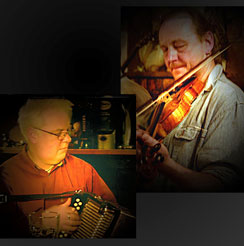
by Neil Brookes and Tony Weatherall
£4.99
Overview
Neil Brookes: Fiddles and Flute.
Tony Weatherall: One-Row and Two-row Melodeons.
All the tunes on this album are to be found in a collection of tune books from North Shropshire. Some are dance tunes, whilst others have military connections from the time of the Napoleonic wars. Very few are found in other sources, and from their titles, many appear to be the work of local musicians. Four manuscripts bear the signatures of John Jones (dated1801), James Blackshaw (1837), Richard Hughes (1823) and Albert John Hughes (undated).
They are owned by Mr Richard Hughes, of Ash, Shropshire. A book by John Clews (1823) is owned by Mr John Hardy, of Audlem, Cheshire. We thank them for their help in our quest to recover some of the lost tunes of the nineteenth century.
Our intention has been to stay close to the music as written, though inevitably our individual styles have modified tunes slightly. We have allowed ourselves the freedom to add harmony where appropriate. Reference numbers in brackets give the initials of the compiler and the relative location of each tune in the collections.
THE MANUSCRIPTS This collection of tunes is selected from five handwritten manuscript books, dated between 1801 and 1837. Four of the books were compiled by members the family of Mr Richard Hughes, from Ash, near Whitchurch, Shropshire. The fifth was the tune book of Mr John Clews from Stoke Heath, Stoke upon Tern, Shropshire. It is not certain that they represented the complete repertoires of the musicians who wrote them, but they give us a valuable record of tunes that were popular at the time.
John Clews 1832
The Clews manuscript (dated 1832), together with two handwritten books of hymns and psalms, was discovered during a clear out of a farm loft at Stoke upon Tern. The owner of the farm was the grandfather of Mr John Hardy of Audlem, Cheshire. John, a fiddler and farmer himself, tells us that Clews worked at the Stoke farm as a labourer. The book contains 44 tunes, a number of which are unusual in being arranged for two or three players. Not many of the tunes are associated specifically with dancing, although a few minuets are included, and towards the end of the book the content has a Scottish influence.
John Jones 1801
The four books bearing the signatures of John Jones, Richard Hughes, James Blackshaw and Albert John Hughes were discovered in the loft of the current owner, whose name is also Richard Hughes. A fiddle, two flutes and a clarinet, were also found along with the books. All four musicians are related to Mr Hughes and came from farming backgrounds. We believe that Hughes, Clews and Blackshaw were also associated with Ash village church band. From Mr Hughes family tree, John Jones is related to the Hughes family as the father of Mr Hughes grandfathers grandmother. His tune book is the earliest of the collection and the style reflects an earlier period accordingly. He includes one or two songs, usually with only the first line or verse. There are 128 tunes in his book.
James Blackshaw 1837
James Blackshaw was a clarinet player and farmed Ash Fields. According to Mr Hughes family history, he played at the inauguration of Ash Church in 1837, and would almost certainly have known John Clews. His tune book contains some 120 tunes of wide ranging style, including quadrilles, quick steps, and some tunes with titles referring to local places. His daughter Sarah married the current Mr Hughes Grandfather in 1870.
Richard Hughes 1823
Richard Hughes was the uncle of the current owners grandfather and was a fiddle player. His collection of 168 tunes was commenced in 1823, when he would have been 14 years old, and contains some very fine hornpipes, reels and other dance tunes. There are many pieces that reflect the music of the Napoleonic Wars and the local interest in Lord Wellington and Lord Hill. The picture of him with his fiddle suggests that he was an accomplished musician. Born in Tushingham, near Whitchurch, he lived most of his life at Beech Cottage, Whitchurch. Mr Hughes tells us that he performed for local soirees, which may have included dancing. He apparently asked for no fee, save that he was fed, watered and transported to the venue. His duties for the evening sometimes included the carving of the roast! He died in 1886, leaving no children.
Albert John Hughes (undated)
Albert Hughes was the uncle of Mr Hughes and was born in 1886. Mr Hughes believes the work to be earlier, and that it is probably the work of Richard Hughes. If so, it is likely that the contents represented a separate repertoire that was used for dance purposes. Two of the 31 tunes (which include several quadrille sets) have dance instructions written below the stave.
Reviews
Related Albums