Away in the West

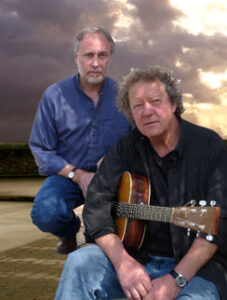
by Mick Ryan & Paul Downes
£9.99
Out of stock
Overview
Another albums of songs mainly from the pen of Mick Ryan but this time with the collaboration of Paul Downes.
Supported by
Paul Hutchinson – accordion
Jackie Oates – fiddle
1 THE PAUPER’S PATH (Words and music – Mick Ryan).
The path from the road to the front of the workhouse was, apparently, know by this name.
The BBC’s wonderful testimonial history of the twentieth century, ‘The People’s Century’, inspired this song.
This is from my 1995 show ‘A Day’s Work’. A group of farm workers sing this as part of the mummers’ play of death and resurrection which is later tragically replayed on the western front in 1916.
This is based on a story recalled from childhood. I have since found it in Grimms’ Fairy Tales as ‘Hans In Luck’. Memory has changed some of the details. The main features of the story, however, remain remarkably unchanged. Which just goes to show how the ‘folk process’ tends to retain the essential core of a tale.
A traditional song learned from A. L. Lloyd.
6 SOUTH ARMAGH (Words – Mick Ryan, Music – Trad.)
In 1992, I was invited to participate in a ‘singing weekend’ in Forkhill, South Armagh, known in the media as ‘bandit country’. I travelled there with some trepidation. I left in a different frame of mind. The tune is that of a song, ‘Sarah Jane’, which I heard at the festival. We’ve changed the time signature.
Waveney Folk Club, Lowestoft, is held in the converted cellar of an early 19th century theatre, now an arts centre. On the walls of the rooms above are framed play bills of its earliest days. The title is a reference to the catchphrase of the circus owner, Sleary, in Dickens’ ‘Hard Times’. Thanks to Carol and Chip for sending me photocopies of the posters.
Written after the death of my father.
Loosely based on George Mackay Brown’s historical novel of the same title. The book has the same kind of stark and compelling quality found in some of the poems of Ted Hughes, or the songs of Dave Goulder. The story is set in Shetland, and beyond, in the 11th century. It is now widely accepted that the area of what is now Cape Cod was briefly settled at that time by Norsemen under Leif Ericson. It was so named from the report that grapevines were found growing there. In Brown’s story, it is, I think, a symbol of lost innocence.
A visit to the National Trust Workhouse Museum, Southwell, Notts., brought this one about. When there was no useful work for the paupers to do, they were put to ‘turning the mill’. This was a two-man crank handle either side of a stiffly geared drum. It produced nothing but sweat and virtue, both of which had to be suffered in absolute silence, as had just about every other activity in the institute.
The lark is, for me, always a symbol of permanence and freedom. The tune is Irish (‘My Lagan Love’).
This was inspired by Brian Keenan’s account of how he coped with solitary confinement.
This is from my 1998 folk opera ‘The Voyage’. An emigrant mother addresses her infant child.
After my visit to the Workhouse Museum, I wondered how the inmates coped with the rule of silence.
Reviews
Related Albums


