When Every Song was New

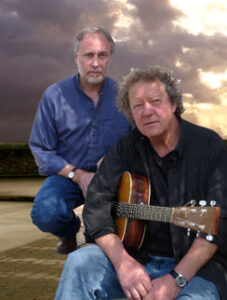
by Mick Ryan & Paul Downes
£9.99
Overview
This new album is due to contain more traditional material than past albums and contains many songs from Mick’s past. It is supported by several musicians:
MICK RYAN – Vocals
PAUL DOWNES:- Guitar, Five string Banjo, Tenor Banjo, Mandolin
Maggie Boyle:- Flute, Bodhran
Gill Redmond – Cello
Keith Kendrick – Concertina
Tom Leary – Fiddle
aul and I were born in the same year, and we both first came to folk music in our teens. Paul went to Exmouth Folk Club at the age of thirteen, became a regular there and, shortly after, at the ‘Jolly Porter’ club in Exeter. Meanwhile, I went to the ‘Swindon Folksingers’ Club’ at the age of sixteen and, like Paul, quickly became absorbed in the learning and singing of songs.
The idea behind this album, then, is to return to those songs which were, almost without trying, absorbed from the folk scene during these early, formative, years.
One of the four exceptions to this, in that it was acquired fairly recently, is ‘BECCLES GATES’. Mal Jardine of the ‘Bacca Pipes’ club in Keighley, Yorkshire, wrote it with his father, Bill, some years ago. It is the only song either of them has ever written, and Mal therefore describes it as ‘the complete works’. It is included because it demonstrates that, as far as the folk club scene goes, there is life in the old dog yet.
The late great Tony Rose was a native of Exeter and was often to be heard at ‘The Jolly Porter’. Frequently booked at the Swindon club, he exemplified the best of English style singing, and was a big influence on young singers in the south west. It was from Tony, then, that Paul and I picked up ‘LIMBO’. ‘Limbo’, here, refers to debtors’ prison. However, the ‘Dictionary of the Vulgar Tongue’, of 1811, defines it more generally as any place of confinement. The last verse might, perhaps, be seen as a bit politically incorrect for this day and age, but ‘different times…..’.
‘ONE NIGHT AS I LAY ON MY BED’ is a night visiting song which was collected from Mrs. Marina Russell, in Upwey, Dorset, according to ‘The Penguin Book of English Folk Songs. Given the currency of this collection in the 60’s and 70’s, this will have been where the folk club floor singer who was my source would have learned the song.
One of my biggest influences is the great Irish singer Tim Lyons, and I acquired a number of songs from him. Most of these remain in my ‘private’ repertoire as they seem to require a natural, as opposed to and assumed, Irish accent to do them justice. One song to which this constraint does not, in my opinion, apply is ‘YOU RAMBLING BOYS OF PLEASURE’. This, allegedly, was the source for Yeates’ ‘Sally Gardens’.
Surely one of the greatest songs ever written is Dave Goulder’s ‘JANUARY MAN’. It was widely sung in the 1970’s, and has been recorded by dozens of singers, most notably by Martin Carthy. Neither Paul nor I can recall where we heard it first though.
Every so often, the Swindon club would decamp mob handed to ‘The Bricklayers’ Arms’, in the village of Longcott, Oxfordshire, for a Saturday night singing session. Invariably, at some point, the cry would go up, “Give us ‘KNIFE IN THE WINDOW’ Bill”.Whereupon, an elderly gentleman by the name of Bill Whiting would sing this version of ‘Hares on the Mountain’. At the time, it seemed important to have got a song from a ‘field singer’. Whether there is really much difference between the ‘field’ and the ‘revival’ singer seems less important now, but the song is still a good one.
The song which I have always referred to as ‘The Burning Thames’, is more correctly entitled ‘THE LOVER’S GHOST‘. I got it, at the club, from a singer called Sylvia who, to my recollection, rarely sang anything else. Scarcely surprising, then, that I just ‘picked it up’. The ‘proper’ version is, again, in ‘Penguin’, where it says the song was collected from a Mrs. Cecilia Costello of Birmingham.
The second exception to the rule of being ‘absorbed’ from the folk scene is what I have always called ‘THE OLD JIG JOG’. My father’s father left Limerick in the 1890’s, and spent the next twenty years firstly in Australia, then in New Zealand where he finally joined up, fought at Gallipolli, then on the Western Front, before ending up back home in Ireland. I never met him, but my auntie Maureen told me that he played the fiddle and sang. She recalled this song in particular, though she could only remember a few of the words and a bit of the tune. Nevertheless, it is pieced together here from what is, in fact, Banjo Patterson’s ‘Travelling Down the Castlereagh’.
Another song mentioned by Auntie Maureen was ‘THE LASS OF MAHARALEE’, of which she could remember only the title. I picked it up somewhere along the way, though I didn’t sing it out until taught the tune properly by Pete Harris.
I got ‘A NEW YORK TRADER’ from yet another anonymous floor singer in Swindon. This, too, is in ‘Penguin’. The notes there say that the song is often conflated with the similar, but different, ‘William Glen’. This is, obviously, what the folk club source did!
Swindon Folk Club was run, from 1960 until 2001, by Ted and Ivy Poole, who are still regulars at the club. As a result, there are a number of Ted’s songs here. One of these is ‘THE GREY HAWK’. This is clearly an English country song. There is a female version called ‘The Bonny Boy’.
The third ‘exception’ is ‘SUMMERWATER’. From my earliest memory, my mother, who had as a child participated in a ‘choral speaking’ group, used to recite narrative verse. One in particular haunted the memory. I recalled the title as ‘The Ballad of Summerwater’. The story was more or less as here, and used to scare the living daylights out of me. I tried, for years and without success, to track the poem down in order to set it to music. Finally, having given up, I wrote my own version of the tale. Having first explained the problem of finding the original poem, the song was ‘premiered’ at a Whitby Folk Week ballad session. The moment it finished, however, Mike Tickell stood up and began to recite ‘The Balled of SEMmerwater’!
Another song, learned ‘without meaning to’, from Ted Poole, is ‘GEORGIE BARNWELL’. This is clearly a broadsheet balled. It is sung in snatches by one of the characters in Dickens, which gives an indication of its popularity at the time. The song flows into ‘AMONG THE CROWS AND ROOKS’, an original tune by Paul.
The fourth, and final, exception refers to the learning and singing of songs, which has been an abiding joy. For both Paul and me, this began in childhood, accelerated at our respective folk clubs and has continued ever since. Though the traditional songs here come from my repertoire, Paul was very familiar with nearly all of them, which bespeaks a shared musical experience and culture. ‘WHEN EVERY SONG WAS NEW’ , with new words to a tune adapted by from the traditional ‘When This Old hat Was New’, is a tribute to the folk scene which has given us both so much pleasure.
Reviews
Related Albums


