Burning Bright

by Pete Cooper and Richard Bolton
£9.99
Overview
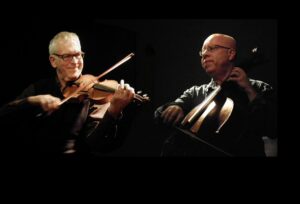
Pete Cooper (fiddle, voice) and Richard Bolton (guitar, 7-string guitar, cello, voice) have been performing and recording contemporary acoustic roots music as a duo for nearly a quarter of a century. They are joined by Raph Mizraki (percussion, bass) for three of the thirteen tracks.
Jenny Coxon, of English Folk Dance & Song magazine, wrote of a previous album – ‘Two superbly innovative musicians at the height of their craft; communicating their love of the material they choose to play, while continuing to explore and develop their repertoire and range. Straightforward traditional English, classical, jazz, blues, world roots: all these performing styles are skilfully utilised, but not at the expense of communicating and sharing the intrinsic qualities of each piece.…Do not miss this superb album.’
For Burning Bright, Pete sings William Blake’s poem ‘London’, in a setting by his Rattle on the Stovepipe bandmate Dave Arthur, and Richard joins him on 1920s vaudeville folk song, ‘Willie the Weeper’, but their set is mainly instrumental. As on the duo’s previous releases it is rooted in traditional British Isles dance music – tunes here are from Somerset, Derbyshire, north Yorkshire and both sides of the Scottish/Northumbrian border, with source fiddlers including James Higgins (1819-1910) and Willie Taylor (1916-2000). ‘Burning Bright’ also features excursions abroad into styles Pete has studied, taught at the London Fiddle School and shared in his numerous publications. Here he and Richard play brigands’ dances from southern Poland, an Appalachian tune from Virginia, three wild Bulgarian ruchenitsas and Brazilian choro classic Tico-Tico no Fubá, as well as Richard’s composition Acton Township. Their eclecticism even extends to a folk interpretation for fiddle and guitar of the famous Allegro by classical composer Joseph-Hector Fiocco.
Link to Folking.com review
Shepton Mallet Hornpipe/ Radstock Jig
Trad, arr Cooper & Bolton
Cecil Sharp visited the Shepton Mallet Union (workhouse) in December 1907, noting down these two hornpipes from the playing of octogenarian Gypsy fiddler James Higgins (1819-1910). Radstock, nine miles north-east of Shepton Mallet, was at that time a mining town in the heart of the Somerset coalfield. The term ‘jig’ is used in the generic sense of ‘dance tune’.
Dene & Pearl
Farewell to the Dene/ The Pearl Wedding by Willie Taylor, arr Cooper & Bolton
Dedicated to Pete’s ‘Folkworks’ friends in the North East. Shepherd and fiddle player Willie Taylor (1916-2000), composer of this strathspey and reel, was, according to Kathryn Tickell, ‘undoubtedly the foremost exponent of the traditional Northumbrian/ Border fiddle style.’ The Pearl refers to the 30th anniversary of his marriage to Nancy, the Dene to their farmhouse. Willie sent Pete the music for some of his tunes after they met at Bracknell festival in 1991, signing his letter, ‘Keep fiddling, even if it’s only the tax.’
Coilsfield House/ Cropie’s Strathspey
Nathaniel Gow/ Alexander Givan, arr Cooper & Bolton
It was for Hugh Montgomerie, an amateur composer and Earl of Eglinton, that Nathaniel Gow (1763-1831), son of Niel Gow, wrote this stately air celebrating the Earl’s home in Ayrshire. The strathspey was composed (as ‘Mr Douglas of Springwood Park’) by Alexander Givan (1752-1803) of Kelso in the Scottish Borders. It was later published under its present title by fiddle player and composer Peter Milne (1824-1908), to whom it has therefore often been attributed.
Bavno Pomashko/ Three Ruchenitsas
Macedonian/ Bulgarian trad, arr Cooper, Bolton and Mizraki
A traditional Macedonian tune we learned from the clarinet playing of Nikola Parov, ‘Nikola and Friends, Traditional Music from the Balkans,’ followed by three tunes in 7/8 for a ‘handkerchief’ dance. Pete taped them in Swansea in the 1980s from fiddler Kate Gaynor, who had picked them up while working as a research assistant on a field recording trip to Bulgaria. ‘The night after I learned them I felt disturbed, with strange dreams,’ says Pete, ‘as if the architecture of my brain was being re-arranged.’ He previously recorded them in 1990 on ‘All Around the World’ (Fiddling from Scratch Tapes).
London
Text: William Blake, tune: Dave Arthur, arr Cooper & Bolton
English poet William Blake (1757-1827) published his ‘Songs of Experience’, including this plaintive poem, in 1794. Dave Arthur, Pete’s bandmate in Rattle on the Stovepipe, set it to music for a 2017 fundraising gig for the Blake Society, which comedian Stewart Lee invited Shirley Collins, Dave and Pete to perform at. The funds contributed to the purchase of a gravestone for the poet on a previously unmarked spot in Bunhill Fields, London.
William Pitt/ Willie Is A Bonny Lad
Trad, arr Cooper & Bolton
We learned these reels from fiddle trio ‘Our Northern Branch’ – Johnny Adams, Chris Partington and Paul Roberts. The first appears as Billy Pitt in Book 2 of the manuscript of North Yorkshire fiddler Lawrence Leadley, of Helperby (1827-1897), and may refer to prime minister William Pitt the Younger (1759-1806), who in 1799 had the bright idea of introducing income tax.
Acton Township
Richard Bolton, arr Cooper & Bolton
Acton Town is a west London tube station near Richard’s home. He and Pete first recorded this tune, which pays homage to the compositions (and little known cello-playing) of Abdullah Ibrahim (Dollar Brand), on a previous album (‘The Savage Hornpipe’, Big Chain 103), but revisit it here with Richard playing the 7-string guitar he has adopted in recent years for Brazilian choro music.
Mountain Brigands’ Dances
Polish Trad, arr Cooper & Bolton
Three Zbójnickie (pronounced Z’boy-nitsky-a, ‘Mountain Brigands’ Dances’) in the key of D from the foothills of the Tatra Mountains in south eastern Poland. The górale (‘highlander’) musicians of the Podhale region sing and play fiddles and a three-stringed cello called basy, while a circle of male dancers carrying long sticks topped with steel axe-heads leap in the air, land in squatting positions, and kick their legs out. The song texts celebrate the nineteenth century, Robin Hood-like figure of Janicku (pronounced ‘Yanitz-ku), who in Habsburg Empire days led raids on travelling merchants and the military. The first and third tunes are in the Lydian mode, with its distinctive sharpened fourth (G#). Janicku Gibki (pronounced ‘Yanitz-ku Gib-key’, ‘Bold Janicku’); Tancyli Zbójnicy (‘Tant-silli Z’boy-nitsky’, ‘Brigands Were Dancing’); and Do Zbójnickiego (Doh Z’boy-nitsky-eh-go, ‘Go, Brigands!’).
Willie the Weeper
Ernest Rogers, arr Cooper & Bolton
This vaudeville folk song was written by singer and guitarist William Ernest Rogers (1897-1967) of Atlanta, Georgia, columnist and editor at the Atlanta Journal from the 1920s until 1962, and he recorded it for Columbia Records in 1925, and then for Victor (1927, 1928). It presumably influenced Cab Calloway’s 1931 hit, Minnie the Moocher. Pete first learned it from a 1974 album by underground cartoonist R. Crumb, ‘R. Crumb’s Cheap Suit Serenaders’.
Harper’s Frolic/ Bonnie Kate
Trad, arr Cooper & Bolton
Two Derbyshire tunes from the Ashover manuscript (1762-1775) of Joshua Harrison and David Wall (see Village Music Project website), which Pete had the privilege of playing at The Blue Ball pub, Norland, with members of the New Victory Band, when he was living in West Yorkshire in 1979-80. The tunes were the opening track of the band’s album ‘One More Dance And Then’, which firmly established them as session favourites.
Fiocco’s Allegro
Joseph-Hector Fiocco, arr Cooper & Bolton
Born in Brussels, his father an Italian composer, Joseph-Hector Fiocco (1703-41) was principally a church musician, including choirmaster at Antwerp Cathedral, but is best known to violin students for this Allegro. ‘Vitality in tone and rhythm. Occasional passages not quite under the fingers, but in the main a safe L. H.,’ noted the examiner when 16-year-old Pete passed his Grade 6 exam in 1967. Later, working with Suzuki method teacher Jane Afia-O’Connor, he memorised the piece, which became a favourite of his mother’s when he played it for her in her care home; she tapped along on the lid of a box of Thornton’s chocolates.
Cuffey
American trad, arr Cooper, Bolton and Mizraki
Cuffey, an anglicisation of the Ghanaian boy’s name Kofi, meaning ‘born on a Friday’, was a name given to enslaved Africans in North America. The tune, collected by Armin Barnett of Seattle from N.H. ‘Nicky’ Mills, of Boobe’s Mill, Virginia, and recorded by the Highwoods Stringband (‘No. 3 Special’) in 1976, was a hot festival tune in 1978 when Pete first visited West Virginia. He recorded it with Rattle on the Stovepipe (‘Eight More Miles’), but he and Richard give it a more bluegrass treatment.
Tico-Tico no Fubá
Zequinha de Abreu, arr Cooper, Bolton and Mizraki
Brazilian composer Zequinha de Abreu (1880-1935) wrote this classic choro tune in 1917, with Aloysio de Oliveira’s Portuguese lyrics, ‘Sparrow in the Cornmeal’, added later. It subsequently became the most famous of all choro tunes, performed by musicians in many different genres and often far from Brazil. The Andrews Sisters had a chart hit in 1944 with their English language version. Pete learned it in 1984 at a hippie commune in southern France from a Dutch sax player called Annemick.
Reviews
Folk London
Pete Cooper & Richard Bolton Burning Bright WildGoose Records WGS4445CD
The London-based duo of fiddler Pete Cooper and multi-instrumentalist Richard Bolton have been performing together for nearly a quarter of a century and Burning Bright is their fourth album. As with their previous three albums, it is firmly grounded in English dance music, the pair blending brilliantly. Their enjoyment in playing together is evident throughout this album, making it a delight from start to finish. The 11 tunes are broken up by two contrasting vocal tracks, both ably performed by Pete. The first, their arrangement of Dave Arthur’s setting of William Blake’s descriptive poem London with a beautifully melancholic cello accompanying Pete’s restrained vocal, paints a familiar picture. Published in 1794, some things just don’t change over time. The second song is Willie The Weeper, which quickly became a firm favourite. A relative of Minnie The Moocher, the story is one of a chimney sweep’s erotic dopeinduced dream, from which trip he emerges sooner than he would have wished. Pete and Richard’s fiddle and guitar accompaniment capture the 1930s vaudeville jazz scene wonderfully with some superb guitar from Richard. The varying range of styles of the 11 tunes are well balanced, maintaining enjoyment and interest throughout the 50 minutes. Two distinctly English dance tunes, Shepton Mallet Hornpipe/Radstock Jig, open the album in a lively fashion and firmly establish how well the combination of cello and fiddle work together, both instruments taking the lead in turn. This is followed by two tunes from the late Northumberland fiddler Willy Taylor, Farewell To Dene and The Pearl Wedding. Combined here as Dene & Pearl, they feature Richard accompanying Pete with some very precise rhythmic guitar playing, an instrument he uses to great effect on the first of their foreign excursions, Bavno Pomashko/Three Ruchenitsas. This features some exciting percussion from Ralph Mizraki, who also plays double bass on the energetic old-timey American fiddle tune Cuffey. One highlight worthy of mention is Joseph-Hector Fiocco’s Allegro, a challenging classical piece which Pete has had under his belt since 1967. The album concludes with a choro, a Brazilian instrumental popular music genre which originated in 19th-century Rio de Janeiro and is guaranteed to leave you smiling. Flawlessly produced and presented including an informative eight-page booklet, this is a treat from start to finish.
Brian Cope
EFN
Burning Bright is an engaging album with a broad mix of material from the British Isles, Continental Europe and the Americas. It is the fourth album the duo has made in nearly 25 years of playing together, during which time they have developed a tight listenable sound. The music ranges from 18th century baroque through to traditional tunes collected in the 20t” century, along with various compositions, including a setting of a William Blake poem `London’ which is delivered in a moving style complemented by the excellent melody composed by Dave Arthur.
The tune sets from the British Isles are mainly well‑known ones played in an energetic style with beautiful interplay between the fiddle and cello. Less familiar music from the Balkans and southern Poland is performed in a very accessible way, without compromising the compound rhythmic pulse and unusual scales. The three items from North and South America, a vaudeville song ‘Willie the Weeper’, an Appalachian fiddle tune and the well‑known Brazilian choro tune ‘Tico‑Tico’ all sit comfortably alongside the European material and reflect the wide range of styles which this duo perform and present in an accomplished and entertaining manner. However, the highlight of this CD is Pete and Richard’s performance of Fiocco’s Allegro, a baroque piece which Pete learnt as a youngster when he was having classical violin lessons. For me this album shows it is possible to cross over from classical violin to folk fiddle, popular music and back again. The CD comes with an informative booklet with attractive artwork. I really enjoyed listening to Pete and Richard’s playing and thoroughly recommend this CD.
DAVE SHEPHERD
Folking.com
I do like an album on which the tracks all have interesting stories behind them, and Burning Bright by Pete Cooper and Richard Bolton, is just such an album. This is the fourth album that fiddle legend Pete and multi-instrumentalist Richard have made, during a quarter of a century working together. As with previous albums, Burning Bright is rooted in British folk, but there’s much more besides. As well as traditional British tunes, from various source fiddlers, there’s dance music from around the World, classical, jazz, vaudeville, and Brazilian choro music. And if you’re wondering about the album title, there’s some William Blake too.
On Burning Bright, Pete plays fiddles and sings the two vocal tracks. Richard supplies the harmony vocals, and plays guitar, cello, and a seven-string guitar that he’s taken up for Brazilian choro music. They’re joined by Ralph Mizraki with percussion, and also double bass on one track.
We start in Somerset. More particularly, the Shepton Mallet Workhouse, where Cecil Sharp collected two tunes from octogenarian Gypsy fiddler James Higgins. ‘Shepton Mallet Hornpipe’ and ‘Radstock Jig’ are two very English dance tunes, played on fiddle, with accompaniment on guitar and cello.
The opening of the second track has an unmistakeably Scottish feel. ‘Farewell To The Dene’ is a Strathspey – a type of reel originating in the Spey Valley – although this one comes from Northeast England. Willie Taylor was a Northumbrian shepherd, a leading fiddler in the Northumbria-Border style, and composer of both tunes on this track. ‘Farewell to the Dene’ is followed by a lively reel called ‘The Pearl Wedding.’ Together they give the track its name, ‘Dene And Pearl.’
The following track has another Strathspey, but it opens with ‘Collsfield House,’ composed by Natheniel Gow, son of the better known Niel Gow. It’s a refined, stately tune, played on fiddle and cello, which brings to mind the balls in grand houses that we’ve seen in many a costume drama. The tempo quickens with ‘Cropie’s Strathspey,’ composed in the eighteenth century by Alexander Givan, of Kelso in the Scottish Borders.
A melancholy Balkan guitar opening to the next track, heralds the first trip overseas. The set opens with ‘Bavno Pomashko,’ a traditional Macedonian tune. The tempo picks up as the fiddle and percussion join in, but it retains a sombre feel. By contrast, it’s followed by ‘Three Ruchenitsas,’ – Bulgarian handkerchief dance tunes – which lift the tempo.
The first of two vocal tracks follows, a setting by Dave Arthur of William Blake’s Poem ‘London.’ It might have been published 230 years ago, but the words retain their emotional power.
In every cry of every man
In every infant’s cry of fear
In every voice: in every ban
The mind forg’d manacles I hearI remember being disappointed to learn the phrase that so hauntingly evokes internalised oppression, ‘Mind forged manacles,’ wasn’t in the original draft. It replaced ‘German forged Links,’ when that was judged to be dangerously seditious in Georgian London. Perhaps I should have just been pleased that the definitive version is so much better.
This setting was written for a fundraiser to put a memorial stone on Blake’s unmarked grave. It’s beautifully sung by Pete, while Richard’s cello provides perfect accompaniment. A lovely track.
After the plaintiveness of ‘London,’ come two lively English dances. The first ‘William Pitt’ comes from the manuscript on nineteenth century Yorkshire fiddler Lawrence Leadley. The title might refer to William Pitt the Younger. The second tune is another traditional reel, ‘Willie is a Bonny Lad.’ As on other tracks, the combination of fiddle and cello gives this, for me, a very eighteenth century feel.
Richard’s composition ‘Acton Township’ follows. The name comes from a London station and the tune celebrates South African jazz legend Abdullah Ibrahim, a leading exponent of the Cape Jazz sub-genre. Richard’s seven-string guitar is prominent here. Sounding almost like a kora, is sets up an African vibe that continues throughout this joyful tune.
To Poland next, for a set of ‘Mountain Brigands’ Dances.’ These dances, from Southeast Poland, were traditionally performed on fiddles and a local type of three-stringed cello. Fiddle and conventional cello are used here. The dances are performed by men waving long sticks. That might sound like Morrise dance, apart from that the Brigands’ sticks are topped with steel axe heads.
A vaudeville number follows. ‘Willie the Weeper’ was written by singer, guitarist, and journalist William Ernest Rogers, who first recorded it in 1925. This has a real prohibition era feel, with some Central European touches that are often heard in American stage music. The title character is a chimney sweep, with a bad dope habit. Stoned one day, he dreams of fabulous adventures in exotic places. Then, just as his amorous desires are about to be satisfied – the dope wears off. This is good fun.
Two Derbyshire tunes, from the eighteenth century Ashover Manuscript provide the last blast of English dance music. ‘Harper’s Frolic,’ is suitably frolicsome. ‘Bonnie Kate’ is gentler but retains the cheerful feel.
There have been plenty of classical arrangements of folk music, but the next track is a folk setting of a classical piece. ‘Fiocco’s Allegro,’ was written by eighteenth century composer and church musician Joseph-Hector Fiocco. It’s another refined tune, but with a sense of fun. The fiddle leads, but the guitar accompaniment provides an extra dimension and adds some pizzazz.
A good bit of toe-tapping, American old time fiddle music follows. ‘Cuffey’ is a traditional tune, taking its title from a name commonly given to male slaves, and collected in Virginia. Here, it’s given bluegrass treatment with guitar, fiddle, and double bass.
Burning Bright ends with a classic Brazilian choro tune, ‘Tico-Tico no Fuba.’ Appropriately the seven-string guitar leads off this infectious tune, composed by Brazilian composer Zequinha de Abreu in 1917. It’s one of those tunes you’ll probably recognise, without necessarily knowing what it is, and it provides an upbeat conclusion to the album.
Burning Bright is a lovely album. The eclectic mix of material covers an impressive range of styles, locations, and emotions. The arrangements by Pete, Richard, and on two tracks Raph Mizraki, are intelligent and well-constructed. This is an unpretentious album. Just highly accomplished and talented musicians, playing music they love on a range of instruments. It might be limited in its appeal and could be seen as one for serious lovers of folk and roots music. But there’s absolutely nothing wrong with that.
Graham Brown
Folking.com – Graham Brown
‘Burning Bright is a lovely album. The eclectic mix of material covers an impressive range of styles, locations and emotions. The arrangements by Pete, Richard, and on two tracks Raph Mizraki, are intelligent and well constructed. This is an unpretentious album. Just highly accomplished and talented musicians, playing music they love on a range of instruments…’ Graham Brown, folking.com
Related Albums
